 ListOutlook
Stoneware vs Porcelain Dinnerware: Which Should You Buy?
Stoneware and porcelain account for most of the dinnerware sold — and most of the confusion. They are both ceramics, but they are fired differently, and that one difference drives everything else: weight, look, durability and price.
How each is made
Both start as clay. Stoneware is fired at high temperatures until the clay vitrifies — fuses into a mostly non-porous body. It is typically left a little thicker and often finished with coloured, matte or reactive glazes.
Porcelain is made from finer, more refined clay (kaolin) and fired hotter still, until it is fully vitrified and non-porous. The finer material allows thinner walls and crisper shapes than stoneware can manage.
Weight and feel
Stoneware is the heavier, chunkier option — a stoneware dinner plate has real heft, which many people read as sturdy and relaxed. Porcelain is lighter and thinner in the hand, with a more formal feel; thin porcelain rims can even be slightly translucent against a strong light.
Durability in daily use
Both chip if knocked hard against taps, granite counters or each other — no ceramic is chip-proof. Stoneware's thickness helps it shrug off small knocks, but its glazed edges are still the weak point. Porcelain's body is harder, which generally makes it more resistant to cutlery scratching and grey metal-marking from knives and forks.
Both dislike thermal shock: a cold plate into a very hot oven, or a hot plate under a cold tap, is how ceramics crack. Let pieces come toward room temperature first.
Look, price and care
Stoneware suits a relaxed table — earthy colours, speckles, reactive glazes where no two pieces are quite alike. Porcelain is the classic formal white, and it shows food cleanly. As a rough rule porcelain sets tend to cost more than comparable stoneware, though brand and piece count move prices more than material does.
Care is similar: most sets in both materials claim dishwasher and microwave use, but claims vary by set and by glaze (metallic rims are the usual exception). We show the dishwasher and microwave rows on each product page only where the listing itself states them — check there before you buy.
Keep comparing
From the index
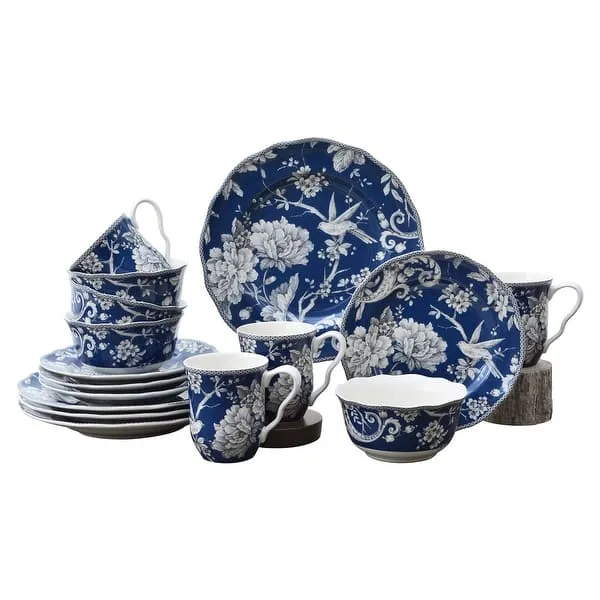 222 Fifth
 Porcelain 16-Piece Dinnerware Set — Service for 4, Vintage
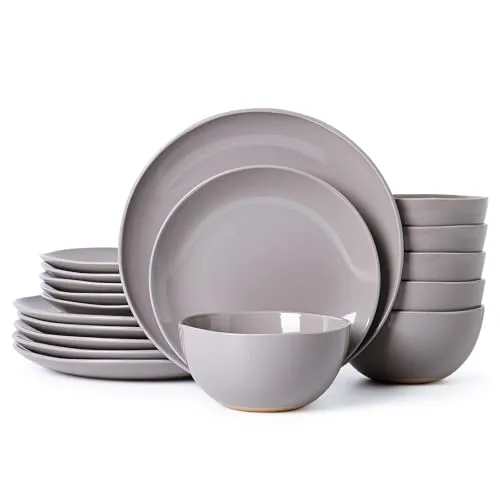 ALOFMO
 Stoneware 18-Piece Dinnerware Set — Service for 6, Grey, Modern
 ALOFMO
 Stoneware 12-Piece Dinnerware Set — Service for 4, Beige
 AmorArc